Monday, January 11, 2016

Course Update, 1/11/2016

3 Pond in its Winter State
Winter has finally arrived, and some of the coldest air of the season has invaded our area.  I wanted to take a minute and share some of my observations over the last 4 weeks.

18 green receiving a mow on 12/9/15
Mowing fairways on December 22. Quite shaggy!
Clipping yield from 18 green, 12/9/15


December brought record warmth to our area.  The green and fairway turf was mowed and plant protectants were reapplied in those areas.  The decision to do this is not a easy, cut and dry one to make, but one that was necessary IMO for the long term health of the turf.  Growth regulators were included in the reapplication to minimize growth in case the warm weather continued, which it did for a bit, albeit not the 60's we saw earlier in the month.  As of this morning, all areas are clean of disease.
Topdressing 18 green
1 green after sand was applied


The warm December allowed us to continue adding topdressing to greens to continue to protect the crowns from any cold injury due to exposure.  It also kept the soil from freezing, which was key for any rain events we received over the course of the month.  A great example is over this past weekend, when the course received 1.75" of rain Friday and Saturday.  Thanks in part to the unfrozen soil, open holes from our November deep tine aerification, and a late season wetting agent application that aids in moving water away from the soil surface, all surfaces were dry before the temperatures dropped and any standing water could freeze.  Remembering our ice adventures from a couple of years ago, I was quite happy to see that!   The dangers of ice to Poa annua greens and our experiences are explained here and here to refresh your memory.  
#5 after this past weekend's weather event
No ice, just a dusting of snow on green surfaces


17 Green
With temperatures now forecasted to be below normal, additional snow cover would be highly beneficial to further insulate the crowns of the plants.  Poa annua is resilient, but susceptible to deep cold injury.  While it is "so far, so good" in regards to turf survival over the winter, the situation is one that will be continuously monitored and sampled.

If you have any questions, contact me at ryan@elconacc.com.  Stay warm!

Ryan

2015/16 Tree Work


(Editor's note:  This was supposed to be posted on January 2, 2016, but did not due to a technical error.)

A beautiful December sunrise
If you took advantage of the warmer golf weather that December brought, you may have noticed the tree work that has been accomplished within the last few weeks, and may have questions on the reasons why certain trees were removed.  Elcona's tree removal strategy revolves on continuously improving playing conditions and turf health on the golf course, while maintaining the integrity and playability of each hole. Trees are a tremendous asset to Elcona's golf course, as long as they are the right tree in the right location.

The impact of tree roots and nutrient competition  to a turf stand.
Some trees can be targeted for removal discussion based on their proximity to fairways or greens, their impact on the surrounding turf health (too much shade and nutrient competition), while others are targeted because they are growing into other, more desirable trees.  Others are removed for their own failing health or the large amounts of debris and litter they produce.  The picture above shows quite healthy turf outside of the tree rootzone, which is clearly defined by the brown turf.  Below I have identified a couple areas and the reasoning behind their removal.

Right side of 6 with a couple Sugar Maples removed

#6/16 before removal


This area above is on the right side of 6, both off of the tee and in the rough short of the bunker.  This area is a popular spot for wayward tee shots, but is quite thin in terms of turf cover due to many Maple trees, in terms of their maturation, high shade cover, and robbing the micro-environment of nutrients that the turf uses to thrive.  The above left picture shows an example of the thin turf cover and bare areas that are typical in this situation.  This removal will increase the amount of sunlight to the area and create a better environment for turf to grow, while still providing a challenge for any wayward tee shots.

#1 from the landing area.
The area to the right is #1 from the landing area.  The tulip tree behind the green was removed due to the large amount of debris that is rained onto the green, as well as the damage it took from a couple of storms in the past 2 years.  Roots were also beginning to encroach the immediate green surround and impacting the health of the bluegrass.  Two oak trees on the left side of the hole will also be removed later this month whenever the ground freezes.  Both oaks are in sickly shape, one from oak wilt and the other from an ant infestation.

We also have continued focusing our efforts on removing silver maples on property to further reduce those pesky helicopter seeds that are prevalent in the late spring months.  About 10 additional ash trees have been removed due to their succumbing to Emerald Ash Borer damage.

I welcome anyone that has questions on any work done on the golf course to contact me at ryan@elconacc.com, or give me a call at the maintenance facility.

Ryan

Monday, November 9, 2015

Preparing the Golf Course for Winter


While I don't like thinking about it, images like the one of #13 above are sure to be around the corner.  Soil temperatures are hovering in the low 40 degree range already, and I believe I saw a rain/snow mix forecasted for later on this week.  While most forecasts have our winter being warmer and drier than last year, we still will experience very cold and snowy days out here.  The last two winters we have experienced were learning experiences for all turf managers in Michiana, myself included,  and I wanted to share a few things we do to ensure that I give the turf all the resources it needs to survive. These solutions do effect playability somewhat for any late fall golf, but are the best management practices for maximizing winter turf survival.


  • Raising mower heights.  When the weather forecasts dictate a prolonged cold snap, I will raise the height of cut on greens from the normal height of .120" to .135".  Raising height of cut allows more leaf surface for the turf to maximize their photosynthetic capabilities and carbohydrate storage.  Raising height will also lessen stress to the plant and create a deeper root system going into winter.  While raising heights may not create the speeds that summer brings, it is best for the long term health of the greens going into winter. 

Open Vertidrain holes

  • Late season aerification.  On November 2nd, our annual Vertidrain process was completed.  These extra holes create three advantages:  additional channels for spring root growth, aid in relieving any deeper compaction within the rootzone soil profile, and extra drainage capabilities for ice/snow melt to prevent ice formation on the plant surfaces.  


  • Fertility and Plant Protectants.  While we limit nutrients on finely maintained turf during the season to provide great playing conditions, the fall is the best time to feed the turf to maximize carbohydrate storage going into winter.  The more carbs the plant stores, the quicker it will break dormancy when temperatures warm up in the spring.  Nitrogen, potassium, and bio stimulants were applied to fill this vital need this month.  Plant protectants are applied to prevent damage from fungal diseases such as Pink Snow Mold.  

Topdressing protecting the crowns

  • Topdressing.  When growth has ceased for the year, we will apply a thick coating of sand topdressing to bury the crowns and as much leaf tissue as possible.  This sand helps protect and insulate the crown of the plant from any extreme cold temperatures.  This practice was another way more damage was prevented from last winter's ice layer. 

So what if the winter of 2015/16 is similar to 2014?  We know our process for snow and ice removal should it become necessary, and we know that the most important practice is to constantly monitor the green for melting after removal, to prevent any crown hydration injury from water re-freezing.  If any significant ice layers form, we will implement our removal program if the layer is still present after 30 days of formation.  This gives us plenty of time before the 45 day threshold is reached and toxic gas levels start to become detrimental to the Poa.  

Ryan

November Course Notes and Happenings


While the leaf colors exceeded beauty and expectations, they are dropping as fast as we can mulch them.  As I sit in my office on this frosty morning, I estimate we are about 70% done with this quite time consuming process.  The contrast in colors this time of year between turf and leaves are spectacular though!  Here's hoping that we have a few days this month for all of you to come out and enjoy the golf course.

The Vertidrain process on #9
Our contractor was out on November 2nd to Vertidrain our greens.  This process is a solid tine aerification that reaches a depth of 8-9 inches.  The benefits of this late season process is to create channels for new root growth and late fall/early spring drainage.  This process also further smoothed the greens from October's core aerification, and we applied an additional 20 tons of sand as well to fill in any open areas.


Map of Indiana's Drought status, as of 10/27/15
A few of you were asking why the October core aerification was slow to heal this year.  There are a few reasons why our greens are slower to heal perhaps compared to other courses in the area, no matter the frequency we roll them or amount of fertilizer or water we apply.  One major reason is that the turf composition on the greens are 80-90% Poa annua, whose growth habit is non-spreading, unlike Creeping Bentgrass, which is the main turf composition on tees and fairways here. The other major factor is the schedule of timing of this necessary practice.  October soil temperatures are 15-20 degrees on average below those of September, and we lose over 90 minutes of daylight over the course of the month.  The 2 mornings where the low was below freezing really slowed down both the metabolism and growth rate of the plant!  Finally, October was quite the dry month here, where most of Elkhart County is considered now in a moderate drought situation.  Rain water is 10x more acidic than our irrigation water, and that increased acidity makes additional nutrients available to the plant in the soil. Hopefully this provides a bit of agronomic reasoning behind the healing process and its timing.  If you have any further questions, please feel free to contact me either at 574-295-6374 or by email at ryan@elconacc.com.  I am more than happy to discuss anything golf course related!

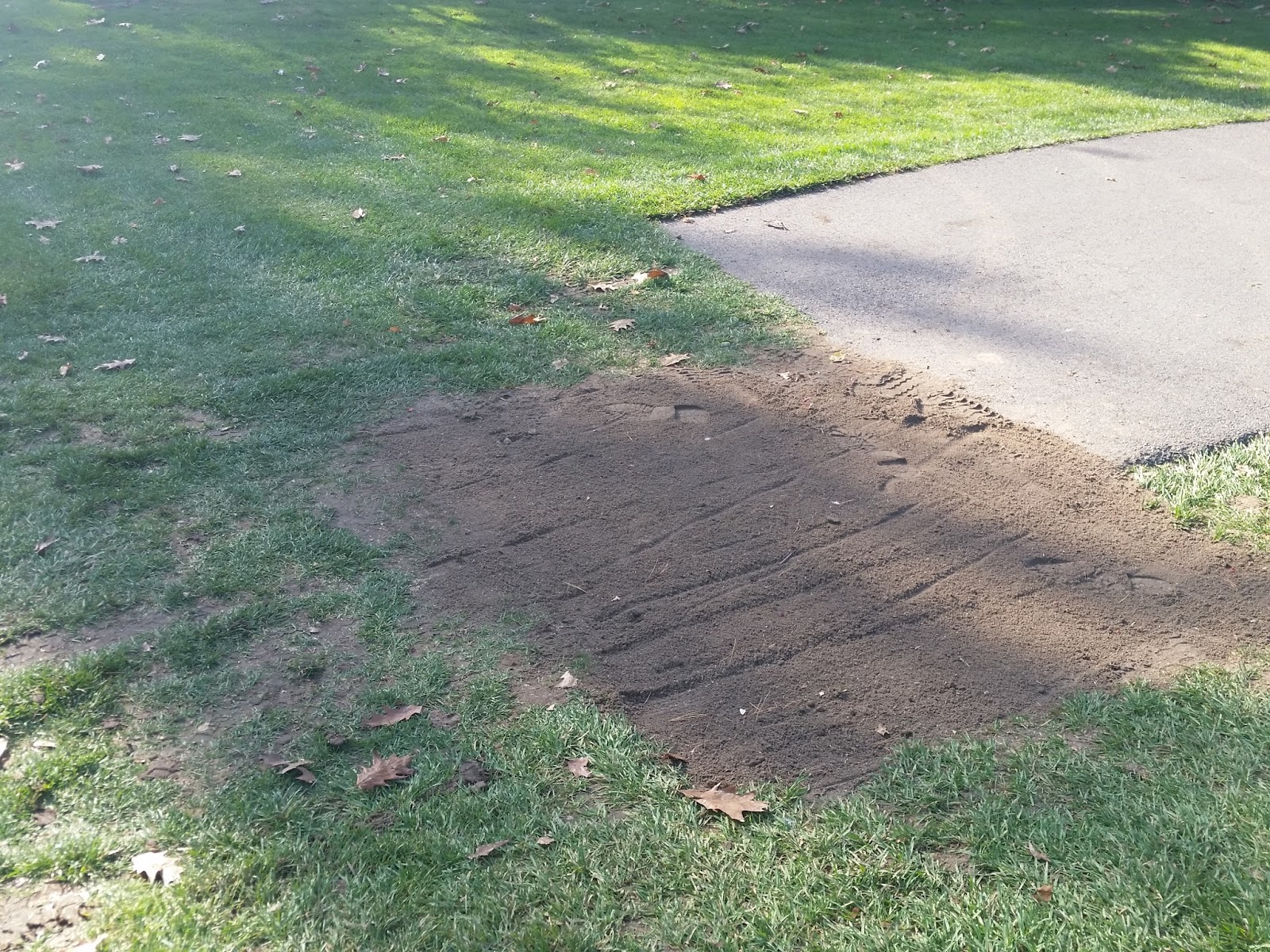
We do have a couple of small projects that the staff and I have or will be starting this month, along with beginning our annual tree work.  The first project involved the cart path entry at 10 green.  All of you have noticed the poor turf conditions that exist at the beginning of that path due to the heavy traffic from both maintenance equipment and golf carts.  What we did here is utilize old rubber matting from Chef Casey's kitchen and placed it at the main entry point, then covered it with a soil/seed mixture.  The thought here is to allow the mat to absorb the brunt of the weight associated with the traffic and allow for increased turf density and vigor there.  The seed will germinate next year and we will use this area as an experiment that hopefully will allow us to learn how to better manage these areas.
Mats placed in hole below turf surface
Poor turf and soil removed at entry point
Seed/soil mix filled on top for new turf
We also are building a new forward tee on the right side of #2, just before the beginning of the fairway.  The new tee will measure 320 yards to the center of the green.  The white tees will then move permanently where the forward tees are located currently.  I will have more information and pictures on this project later this month.


Ryan