Tuesday, August 16, 2011

A Little Help, Please

As you are all aware, we continue to face some agronomic challenges on the golf course.  Some of the challenges are residual effects of the high heat and humidity from a few weeks ago and some have recently developed that we are attempting to get under control (more on this in my next blog update). Lastly, some of the challenges that are ongoing, are ones that can easily be prevented. As I drive around the course each day, I am constantly amazed at some of the things I witness.  Below are some photos of issues that continually occur and lead to additional work for myself and my staff.  Please keep in mind that we have enough problems on our plate right now and don't need additional issues leading to even more set-backs. As always, please click on the photos for a more detailed view.


Unrepaired ballmarks are a constant problem on every green everyday, not just on Monday's.  Please take time to locate your own ballmark and repair it. If everyone repaired their own ballmarks (I am constantly assured that this happens) then there shouldn't be any on the greens. Healing time for an unrepaired or improperly repaired ballmark is drastically longer than one that is repaired correctly.

Unrepaired divots.  Even though my staff will go through and remove many of the divots that don't heal, this is not an excuse to not repair them at all.  Divots left in the fairway take a tremendous toll on our mowers and if several are left in the fairways, we must take an additional step to blow the fairways off before we mow them, or collect them by hand.


Please know that we do not rake the bunkers everyday.  When individuals do not rake their bunkers after playing from them or make a poor attempt at raking them, it leaves a poor playing surface for the groups that follow.  On days when we do not have the bunkers scheduled to be raked and we see many of them looking like the one pictured above, we are forced to put-off other necessary tasks so that the bunkers can be repaired and be made playable to the standards that are expected.  Please consider the groups behind you when raking a bunker and also remember that the bunkers may not be raked the next day and you may have a tee time.

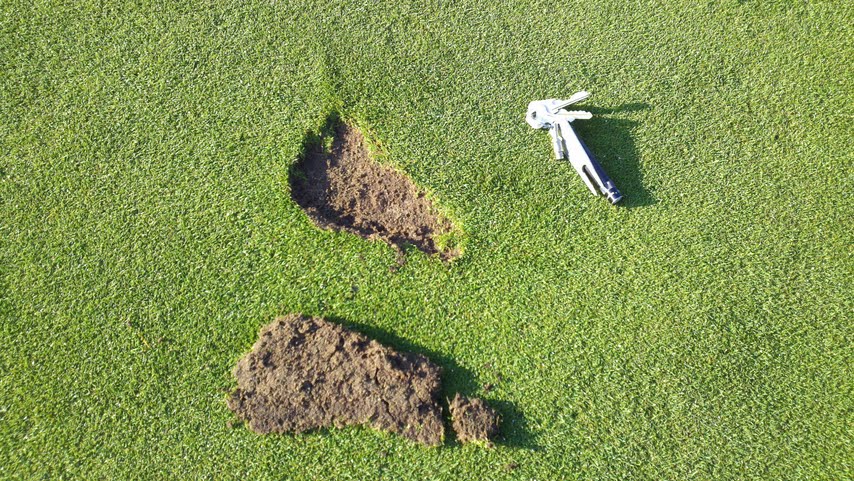
I am fully aware that the greens are slower than we are all accustomed to, but this is no way to take out your frustration.  This lovely divot greeted me on Monday morning as I walked up to the cup on #16 green.  You can imagine my frustration when I saw this.  Situations like this take a significant amount of time to repair because it is imperative that it be repaired in a way that resembles the green before the divot was taken. If not done properly, it will scalp as the mower crosses over it and die or it will lead to an uneven putting surface.

Thank you for your cooperation and please know that we are doing everything within reason to get the golf course back to its normal condition as quickly as possible.  The cooler weather has helped significantly and has led to improved playing conditions.  The greens are still being mown at a slightly higher cut, but I have been comfortable enough to dust off the roller and put it to good use on select days. Stay tuned for another update coming soon.

Saturday, July 30, 2011

Elcona CC Field Guide to All Current Issues

Turf Quality
(Please click on photos for larger view)

When viewing these photos, please know that this has been and continues to be a very abnormal year and it is very rare that we face this many issues in a single season, let alone all at the same time.  Measures have been taken to address all of these issues.  With time and careful management, all of these symptoms will eventually be suppressed.


Physiological Decline (yellowing and thinning of turf) of Annual Bluegrass (Poa annua) in #18 fairway due to extreme heat and moisture.

Dormant Roughstalk Bluegrass (Poa trivialis). Turf still contains healthy stolons and if left in current state would recover, but not until next season.

Localized Dry Spots (LDS).  Notice the proximity and difference in moisture between the two samples.

Despite the fact that we have a fan, we still continue to have thin turf on sections of #12 green due to poor air circulation.

Current Disease Issues

The end result of Pythium in #18 fairway, as well some other smaller areas.  Turf dies in a matter of hours once infected.

Brown patch can be found on several tees.

Summer Patch (as well as a very poorly repaird ballmark) on #14 green.  This disease can also be found on several other greens.

Anthracnose on #16 green.  It can also bee seen on #2, 3, 12 and 15 greens.


Dollar spot from #6 tee.  This is very common and small areas can bee seen throughout the golf course from the tees to the rough.


Friday, July 22, 2011

Sometimes the Best Offense is a Good Defense

I realize that the course updates are starting to be published quite frequently now, and I also realize that this is going to sound like a broken record, but feel it is extremely important to communicate with the membership what is happening on the golf course.

Due to the extreme heat and humidity that we have been receiving for the last week or so, we are starting to see signs of stress caused by heat and disease throughout the golf course.  Within the last day we have seen a few different diseases appear on our fairways, tees and intermediate rough.  Because of the nature of one of these diseases in particular, we now need to take a more aggressive approach in protecting the turf throughout the golf course. On 7/22 all of the fairways and greens will be sprayed with a fungicide to better protect against further disease development.  As of today, we are planning on spraying the tees on 7/23 before play goes off the first tee in the morning.
All of these areas have been sprayed preventatively within the last week or two, but due to the severe conditions some breakthrough in the coverage has occurred. Hence, the need for additional applications.

Pythium fungus in Intermediate cut
   

Close-up of Pythium fungus
An additional change in our current management practices will be the alternating of mowing and rolling the greens.  At least for the next few days, greens will be rolled one day and mown the next.  This will allow for some additional leaf growth which will help the plant better defend itself against stressful conditions.
Dollar Spot

Brown Patch
Please keep in mind that these changes are only intended to be temporary and that the ultimate goal is to provide you with a golf course that you can be proud of during the Walter O. Wells Invitational as well as the rest of the year.  With that being said, until the heat and humidity begin to drop, we will continue to play defense.  As always, I encourage all of you to please contact me with any questions or concerns.

Wednesday, July 20, 2011

Venting of the Greens


Immediately after venting and example of tine size

On Monday, 7/18, all of the greens on the golf course were vented.  Venting is a form of aerification, where numerous tiny channels (1/4" wide x 5" deep) are created within the soil profile (rootzone) of the putting surface. There are several benefits to performing this practice.  The channels help to ease the process of gas exchange within the soil allowing potentially harmfull Carbon Dioxide to be exchanged for Oxygen.  During periods of warm, humid and wet weather like we have had and are currently having, it is crucial for us to be able to let the turf "breathe" and allow excess water to drain more quickly. The end result is a healthier stand of turf that can better tolerate the harsh summer conditions.


Immediately after rolling

With the weather we have had so far this week and looking ahead to the weather that is being forcasted for the next five days or so, this practice will prove to be extremely beneficial.

More on the weather and how it affects the turf will be discussed in a blog post later this week.