Sunday, September 25, 2011

Fall is Here...Finally

I won’t lie, I am very excited that fall has arrived and I’m sure that this does not come as a surprise to any of you.  Instead of re-hashing the difficulty of the summer, it seems more appropriate to look ahead to the colors of the leaves as they change and the cooler temperatures. I have included some pictures from previous falls to remind you of how special a place Elcona CC can be during this time of year.

#3 green

This is a great time of year and just may be my favorite season for playing golf.  Although I never seem to get out and play very often, I still enjoy my time on the course whether it is during my morning tours with Mulligan or on the rare occurrence when I get to spend time on a mower.  The cooler mornings mean that frost delays are getting closer.  I have given the reasons for frost delays numerous times so I will not bore you with the details, just remember that I do not like them either and we will do everything we can to get you out on the golf course as quickly as we can once the frost is gone and our mowing has commenced.


Maple tree left of #15 fairway

To date, aerification has gone extremely well.  The fairways were completed in two days, thanks to new equipment and some fantastic weather.  Tees will be done as the weather allows and greens are scheduled for 10/6, 7.  While greens are being aerified, 9 holes will be closed and 9 holes will remain open and playable.


This fall, we do not have any major “in house” projects other that our usual tree work that we perform each year. Obviously, the renovation of #18 green is a major project, but it will not be completed by our staff. The list of trees to be removed has not yet been completed, but it is safe to say that there will be some changes by #12 green and #13 tee.  Given the struggles we have had with turf in this particular area, tree removal has become a necessity to help improve air flow across the playing surfaces.  We have a number of trees in our nursery that are beginning to mature quickly and need to be transplanted to the golf course before they become too large for our tree spade.  This will need to be taken into consideration when selecting which trees to remove this winter. 
The view down #12 from the tees
For many of you, this is your last month in Indiana before you head to your winter homes. If you head to a different location during the winter, have safe travels and I look forward to seeing you next year.  For those of you that are permanent residents, come on out and enjoy some fantastic golf.  The golf course is in great shape and there are lots of days left before the snow starts flying! 


Tuesday, September 6, 2011

I Know the Benefits, Do You?

It is that magical time of year when the most common phrase heard around the club is: "Just when the golf course looks great again, you are going to destroy it".  The short response to that is Yes, yes we are, but only with the goal of creating healthier turf, and the "destruction" will be short-lived. 
It's aerification time! After an extremely difficult summer, I can think of no better way to help finalize our recovery than by aerifying all major in-play areas.  Many of you probably understand the basics of aerification, but do you truly understand the long term benefits and why there is the need to perform this task multiple times each year?

This photo shows the importance of aerification. The long roots
are taking advantage of the better growing environment in
an aerification hole, while the shorter roots are not
growing in an aerification hole.
 
Everyones first reaction to the benefits of aerification is that it reduces compaction.  While this is true, it most likely is not the most importanat benefit, especially on greens. Creating openings in the soil profile, regardless of whether it is a green, tee, fairway etc. is the primary goal of aerification.  As the name implies, it creates an opening in the soil that will allow for more air (oxygen) to penetrate the soil leading to enhanced root and plant growth.  The holes also lead to an increase in water infiltration.

Another benefit of aerification is the removal of organic matter and thatch. All of our playable areas have very manageable levels of thatch due to our commitment of regular and timely aerification. Do not take this as a sign that we can become relaxed in our approach. If we allow our thatch to begin increasing again, we will be creating a more favorable environment for disease, which, as we saw this summer, we don't need any more of.  Thatch is also capable of holding many times its weight in water.  What does this mean? Softer and wetter conditions. Nobody, including me, wants this.

This is certainly an older photo, but it gives you an idea of how
much soil and thatch is removed. We are now aerifying greens, tees 
and fairways on different weeks to minimize the disruption and
give us ample time to make sure the process isn't rushed.

After summers like the one we had this year, I can't imagine what we would have been faced with if we didn't have the commitment to the cultural practices that we do.  Beginning with spring aerification to the venting of the greens on a regular basis throughout the summer months to the fall aerification that we are now preparing for.  All of these go hand-in-hand and allow my staff and I to provide you with the conditioning that you have come to expect.

As witnessed this season, our program does not always guarantee perfect, disease free conditions all of the time, but it does help set us up for success even during a difficult stretch of weather.

I know that this process is typically not well received and that the timing never seems right, but we must complete this process while the weather is good and while the turf has enough time to recover before the long winter sets in. Since we have purchased two new aerifiers, we can now, with the help of good weather, have all 26 acres of fairways aerified and cleaned-up within three days (last year we were done in two days). Historically, this has been a week long process or more. Remember, the long-term benefits drastically outweight the short-term inconvenience.

If you want an easier way to stay connected to this blog, please enter your email address in the "Follow by E-mail" section on the right side of the main page and a notification will be e-mailed to you whenever I make a new post. Stay tuned for more updates and get out and enjoy your golf course!


Monday, August 22, 2011

Think dimmer switch, not light switch.

After a long and very difficult stretch of weather during most of July and the first part of August, many of the stressed areas on the golf course have begun to heal. When we come to the end of stretches like this (not that we have had one this severe before) it must be understood that we cannot, or will not, rush right back into our normal maintenance practices. Currently, we continue to mow at a slightly higher height of cut on the greens, but a rolling schedule is slowly being introduced since the density on the greens is improving.

The damage that occurred happened quite quickly, but it will take awhile to reach full recovery.  The best analogy I could come up with is a light switch.  We can't just flip a switch and be back to normal.  We have to slowly ramp back up (like a dimmer switch) until we reach normal conditioning. If we rush into recovery, we run a very high risk of taking a step backwards.  Obviously, this is not something we want to see happen.

Cutting Bentgrass sod from our nursery for use on the golf course
After the previous paragraphs, this next statement will probably sound a little hypocritical: I am not very patient when it comes to recovery. With that being said, a number of the larger areas in the fairways that were damaged from the Pythium Blight (see previous posts) are being repaired with sod, as opposed to waiting for seed to germinate.
Installing Bentgrass sod from the nursery on #18 fairway

When recovering from a summer like we have had, the importance of a good nursery is invaluable.  The Bentgrass that is grown on the fairway nursery (see picture) is the same type that is found on our fairways.  Because of this, when it is installed on the golf course, it is a near perfect match and should blend in immediately. We currently have two greens nurseries (established from plugs of the greens on the course), two Bluegrass nurseries and a very large Bentgrass tee/fairway nursery.  Each one of these nurseries is maintained like their corresponding areas on the golf course so that if the need arises, it can be used and have an immediate impact.


On the disease front, we continue to struggle with the disease Summer Patch (Magnaporthe poae). This is not a new occurrence and we have battled with it before. Luckily, it is not as widespread as it was a year ago. Fertility on the greens has been increased and multiple fungicide applications have been made to help with recovery.
An up close look at the hyphae from the Summer Patch pathogen on a root sample taken from one of our greens.

An area on #14 green that was affected by Summer Patch, but is now recovering. Notice the Bentgrass moving into the voids where the Annual Bluegrass was prior to infection.

Lastly, as we continue our recovery, I would like to thank the membership for their support during a year that nobody would like to repeat.  Knowing that there was support behind the tough decisions that were made and that there was, and still is, support as we heal and repair damaged areas, made the season a little more tolerable. This is not the end of the golfing season, hopefully just the end of the stressful weather, so get out and enjoy your golf course!


Tuesday, August 16, 2011

A Little Help, Please

As you are all aware, we continue to face some agronomic challenges on the golf course.  Some of the challenges are residual effects of the high heat and humidity from a few weeks ago and some have recently developed that we are attempting to get under control (more on this in my next blog update). Lastly, some of the challenges that are ongoing, are ones that can easily be prevented. As I drive around the course each day, I am constantly amazed at some of the things I witness.  Below are some photos of issues that continually occur and lead to additional work for myself and my staff.  Please keep in mind that we have enough problems on our plate right now and don't need additional issues leading to even more set-backs. As always, please click on the photos for a more detailed view.


Unrepaired ballmarks are a constant problem on every green everyday, not just on Monday's.  Please take time to locate your own ballmark and repair it. If everyone repaired their own ballmarks (I am constantly assured that this happens) then there shouldn't be any on the greens. Healing time for an unrepaired or improperly repaired ballmark is drastically longer than one that is repaired correctly.

Unrepaired divots.  Even though my staff will go through and remove many of the divots that don't heal, this is not an excuse to not repair them at all.  Divots left in the fairway take a tremendous toll on our mowers and if several are left in the fairways, we must take an additional step to blow the fairways off before we mow them, or collect them by hand.


Please know that we do not rake the bunkers everyday.  When individuals do not rake their bunkers after playing from them or make a poor attempt at raking them, it leaves a poor playing surface for the groups that follow.  On days when we do not have the bunkers scheduled to be raked and we see many of them looking like the one pictured above, we are forced to put-off other necessary tasks so that the bunkers can be repaired and be made playable to the standards that are expected.  Please consider the groups behind you when raking a bunker and also remember that the bunkers may not be raked the next day and you may have a tee time.

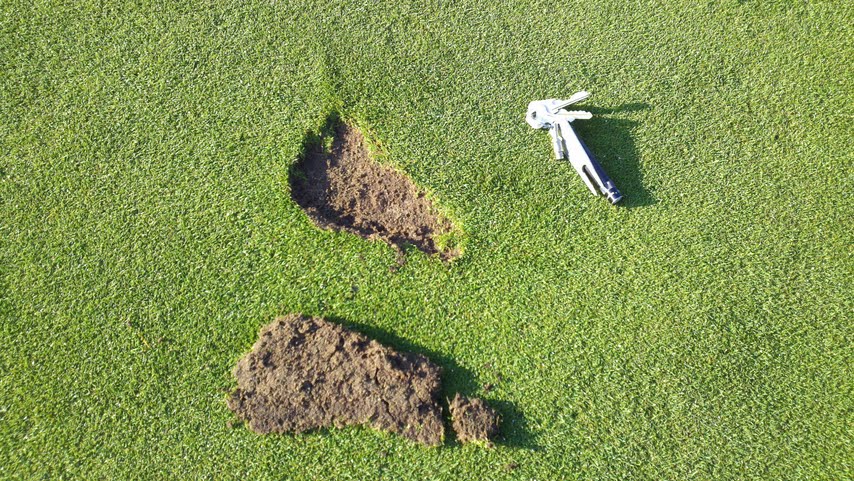
I am fully aware that the greens are slower than we are all accustomed to, but this is no way to take out your frustration.  This lovely divot greeted me on Monday morning as I walked up to the cup on #16 green.  You can imagine my frustration when I saw this.  Situations like this take a significant amount of time to repair because it is imperative that it be repaired in a way that resembles the green before the divot was taken. If not done properly, it will scalp as the mower crosses over it and die or it will lead to an uneven putting surface.

Thank you for your cooperation and please know that we are doing everything within reason to get the golf course back to its normal condition as quickly as possible.  The cooler weather has helped significantly and has led to improved playing conditions.  The greens are still being mown at a slightly higher cut, but I have been comfortable enough to dust off the roller and put it to good use on select days. Stay tuned for another update coming soon.