Monday, November 9, 2015

Preparing the Golf Course for Winter


While I don't like thinking about it, images like the one of #13 above are sure to be around the corner.  Soil temperatures are hovering in the low 40 degree range already, and I believe I saw a rain/snow mix forecasted for later on this week.  While most forecasts have our winter being warmer and drier than last year, we still will experience very cold and snowy days out here.  The last two winters we have experienced were learning experiences for all turf managers in Michiana, myself included,  and I wanted to share a few things we do to ensure that I give the turf all the resources it needs to survive. These solutions do effect playability somewhat for any late fall golf, but are the best management practices for maximizing winter turf survival.


  • Raising mower heights.  When the weather forecasts dictate a prolonged cold snap, I will raise the height of cut on greens from the normal height of .120" to .135".  Raising height of cut allows more leaf surface for the turf to maximize their photosynthetic capabilities and carbohydrate storage.  Raising height will also lessen stress to the plant and create a deeper root system going into winter.  While raising heights may not create the speeds that summer brings, it is best for the long term health of the greens going into winter. 

Open Vertidrain holes

  • Late season aerification.  On November 2nd, our annual Vertidrain process was completed.  These extra holes create three advantages:  additional channels for spring root growth, aid in relieving any deeper compaction within the rootzone soil profile, and extra drainage capabilities for ice/snow melt to prevent ice formation on the plant surfaces.  


  • Fertility and Plant Protectants.  While we limit nutrients on finely maintained turf during the season to provide great playing conditions, the fall is the best time to feed the turf to maximize carbohydrate storage going into winter.  The more carbs the plant stores, the quicker it will break dormancy when temperatures warm up in the spring.  Nitrogen, potassium, and bio stimulants were applied to fill this vital need this month.  Plant protectants are applied to prevent damage from fungal diseases such as Pink Snow Mold.  

Topdressing protecting the crowns

  • Topdressing.  When growth has ceased for the year, we will apply a thick coating of sand topdressing to bury the crowns and as much leaf tissue as possible.  This sand helps protect and insulate the crown of the plant from any extreme cold temperatures.  This practice was another way more damage was prevented from last winter's ice layer. 

So what if the winter of 2015/16 is similar to 2014?  We know our process for snow and ice removal should it become necessary, and we know that the most important practice is to constantly monitor the green for melting after removal, to prevent any crown hydration injury from water re-freezing.  If any significant ice layers form, we will implement our removal program if the layer is still present after 30 days of formation.  This gives us plenty of time before the 45 day threshold is reached and toxic gas levels start to become detrimental to the Poa.  

Ryan

November Course Notes and Happenings


While the leaf colors exceeded beauty and expectations, they are dropping as fast as we can mulch them.  As I sit in my office on this frosty morning, I estimate we are about 70% done with this quite time consuming process.  The contrast in colors this time of year between turf and leaves are spectacular though!  Here's hoping that we have a few days this month for all of you to come out and enjoy the golf course.

The Vertidrain process on #9
Our contractor was out on November 2nd to Vertidrain our greens.  This process is a solid tine aerification that reaches a depth of 8-9 inches.  The benefits of this late season process is to create channels for new root growth and late fall/early spring drainage.  This process also further smoothed the greens from October's core aerification, and we applied an additional 20 tons of sand as well to fill in any open areas.


Map of Indiana's Drought status, as of 10/27/15
A few of you were asking why the October core aerification was slow to heal this year.  There are a few reasons why our greens are slower to heal perhaps compared to other courses in the area, no matter the frequency we roll them or amount of fertilizer or water we apply.  One major reason is that the turf composition on the greens are 80-90% Poa annua, whose growth habit is non-spreading, unlike Creeping Bentgrass, which is the main turf composition on tees and fairways here. The other major factor is the schedule of timing of this necessary practice.  October soil temperatures are 15-20 degrees on average below those of September, and we lose over 90 minutes of daylight over the course of the month.  The 2 mornings where the low was below freezing really slowed down both the metabolism and growth rate of the plant!  Finally, October was quite the dry month here, where most of Elkhart County is considered now in a moderate drought situation.  Rain water is 10x more acidic than our irrigation water, and that increased acidity makes additional nutrients available to the plant in the soil. Hopefully this provides a bit of agronomic reasoning behind the healing process and its timing.  If you have any further questions, please feel free to contact me either at 574-295-6374 or by email at ryan@elconacc.com.  I am more than happy to discuss anything golf course related!

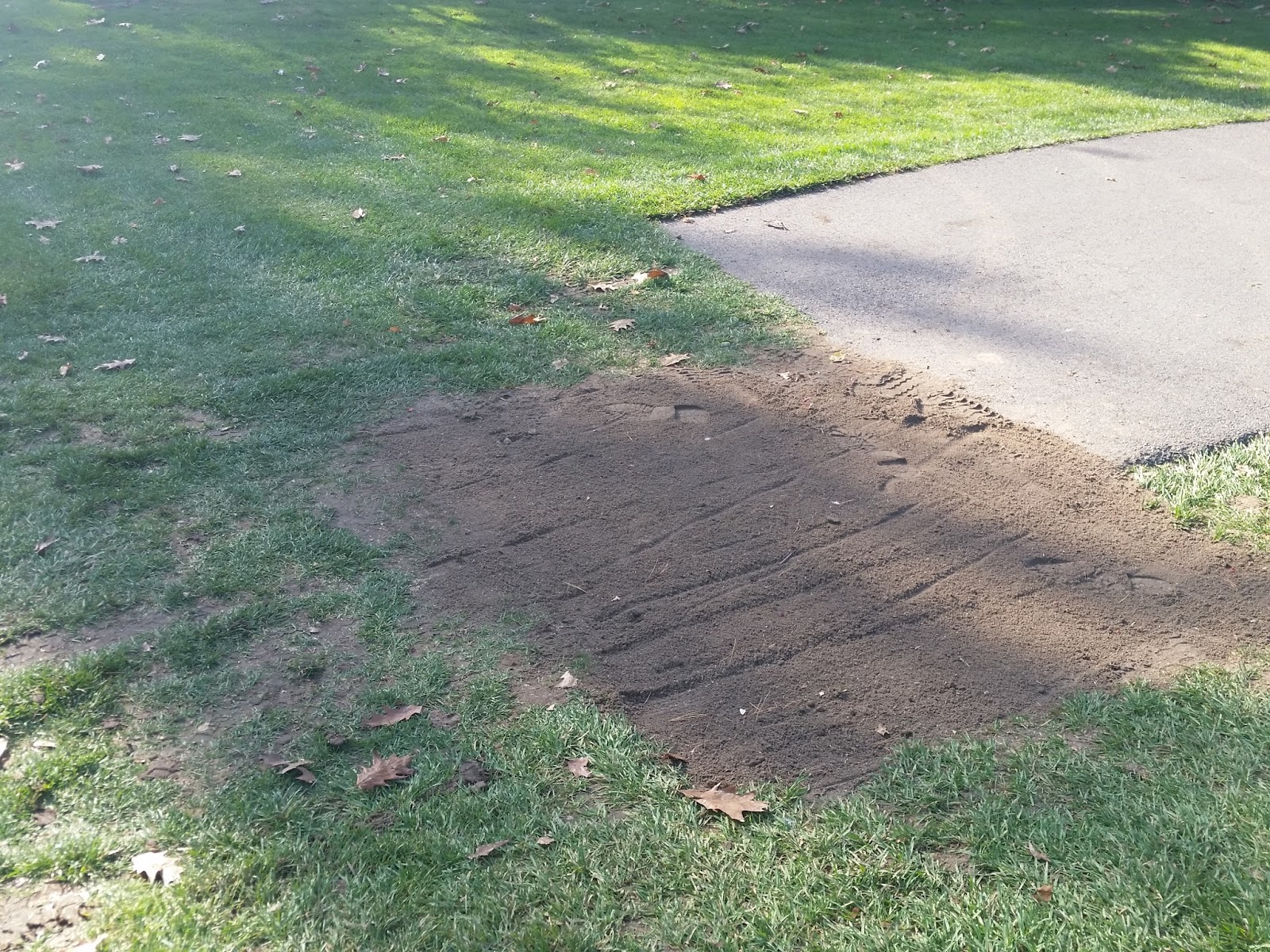
We do have a couple of small projects that the staff and I have or will be starting this month, along with beginning our annual tree work.  The first project involved the cart path entry at 10 green.  All of you have noticed the poor turf conditions that exist at the beginning of that path due to the heavy traffic from both maintenance equipment and golf carts.  What we did here is utilize old rubber matting from Chef Casey's kitchen and placed it at the main entry point, then covered it with a soil/seed mixture.  The thought here is to allow the mat to absorb the brunt of the weight associated with the traffic and allow for increased turf density and vigor there.  The seed will germinate next year and we will use this area as an experiment that hopefully will allow us to learn how to better manage these areas.
Mats placed in hole below turf surface
Poor turf and soil removed at entry point
Seed/soil mix filled on top for new turf
We also are building a new forward tee on the right side of #2, just before the beginning of the fairway.  The new tee will measure 320 yards to the center of the green.  The white tees will then move permanently where the forward tees are located currently.  I will have more information and pictures on this project later this month.


Ryan


Sunday, October 4, 2015

2015 Audubon Review


October is the time of year where I start to take stock in all of our programs, review my notes from throughout the year, and begin forming plans for 2016.  One area that is always on my thoughts is Elcona's Audubon program.  This year our goal was to complete 4 main projects, two of them were centered around increasing pollinator populations.

Nesting evidence on #14 
This past winter, my assistant Kyle and I built 3 wood duck homes and placed them along ponds on #'s 3 and 14, as well as deep in the woods north of 13.  Both houses had evidence of bird activity this year, as the picture on the left shows, but this nest building was from other birds.  One observation from a member was that #3's house was located too close to golf traffic and made it unattractive for wood ducks, which I agree with.  We will be moving it farther south away from #4 tee.  My hope is that someday ducks will utilize these as safe havens to produce their offspring.

Seed to Feed Garden, June 15
Yellow squash
The Seed to Feed garden that I have mentioned multiple times over the past year was a dual achieving project.  One obvious achievement was that, thanks to all members who volunteered their time to maintain it, 6,129 pounds of cucumbers, yellow squash, zucchini, and Dickinson pumpkins were harvested and given to our local food pantries.  That is an awesome amount of produce for our first year.  Also, the garden also served to increase the area for pollinating insects.  One third of our world's food supply is dependent on the help of pollinating insects.  Their populations have decreased some 30% over the last few years, due to multiple biotic and abiotic stresses.  By planting many areas of flowering plants, Elcona can help sustain the local bee population and continue to be a good steward of our community's ecosystem.

Milkweed stand left right of 17
Monarch caterpillar on Milkweed


There were spots in our native areas that we left unmown all year that contained significant milkweed populations.  Milkweed is the main food source for Monarch butterfly caterpillars.  This provided some nice habitat areas for these butterflies to flourish and complete their transformation to butterflies.


Rain garden, July 25th

Bee on a Purple coneflower


We have also multiple areas of wildflower plantings that are in various stages of maturity.  The rain garden that was built in 2012 thrived again this year, with some plants (swamp milkweed) reaching 10 feet in height! There were days that over 100 bees and other pollinators could be seen flying flower to flower, a neat sight for sure.

Area for 2015 plug plantings
Butterfly weed plugs


Wildflower plugs, consisting of cone flower, butterfly weed, and foxglove beardstongue species, were planted west of 12 green.  These plus will, over time, spread via their seed and also provide some great color for that area of the golf course.

Designated OP area on #16
We also seeded additional wildflowers to the left of 16 in our designated "Operation Pollinator" area, as a test of establishment in this fashion.  While this area does not look like much is going on except for fox tail and thistle populations going wild, we are seeing 8 species of different wildflowers taking shape, as the pictures below indicate.  The areas that I planted plugs in last year produced some flowers this year, and began to spread in area, albeit very slowly.

Greg Stump pointing out Coreopsis plants
Black eyed Susan
Gallardia species 
Bachelor Button species


My plan of attack in this area for next year is to renovate the areas that have weeds and grasses in them, and reseed with a wildflower/bluestem seed mixture.  This will decrease the thick grassy weeds and thistle and hopefully provide a more uniform stand of grasses and flowers.  Also, we will be much more proactive in removing any weeds in this area that do germinate.  Finally, we will widen the area of play to create a little more space between the native area and the fairway for any wayward lay up shots, as currently there is only 12 yards between the two.

Our final project was to invite a local birding group for a nature walk along the club's nature trails.  In late May I hosted two individuals from the South Bend/Elkhart Audubon Society, and while they were impressed with Elcona's property and efforts, we were not able to get on their calendar for this year.  Tentatively, we are on their 2016 calendar for a group visit.

Speaking of 2016, Elcona's Audubon committee is meeting this month and will consider many ideas that I will share as the year draws closer to an end.  You can be sure that all will further emphasize Elcona's commitment to both its local ecosystem and the well being of our community. I appreciate your continued support and participation in Elcona's Audubon program, and for giving me the opportunity to learn and grow as a steward of this great property.  If you have any questions, please contact me at ryan@elconacc.com.

Ryan


Thursday, October 1, 2015

Course Notes,10/1/15

Oak tree left of 1 green succumbed to oak wilt
I am sure most of you have noticed the oak tree near 1 green that has rapidly defoliated over the last two months.  I have had a couple of outside experts look at this tree in the last couple of weeks and their consensus is that the tree succumbed to Oak Wilt.   Oak wilt is a fungal disease that affects the vascular system of the tree, and is spread via insects and by root grafts (or conjoined roots of two oak trees) in the soil.  We will be removing this tree when the ground freezes as part of our annual tree work and monitor the surrounding oaks for potential infection.

The staff and I have begun the process of preparing the turf for winter.  We have aerified tees and are in the process of aerifying cart path entrance and exit points, which help alleviate the strain that turf takes from in-season play.

As a reminder, greens aerification will take place on October 8th and 9th, weather permitting.  The first day we will be working on the front 9 greens and the large practice green, with the other 10 greens aerified the following day.  If there are any changes due to weather, I will communicate those to you via the blog.  Fairways will be aerified the week of October 12th, again weather permitting.  The staff and I appreciate your patience and understanding during this necessary agronomic procedure.  If you would like more information on the benefits of aerification, please click here for a great video from the USGA that identify the methods and reasoning behind aerification.

Fall is the best time to apply fertilizer to any turf, whether it be your lawn, or the turf out on the golf course.  Applications have already taken place to tees and green surrounds.  Greens and fairways will be receiving additional feeding through our sprayers as the month progresses to help build carbohydrate storage in the plant for winter.

If you have any questions, please email me at ryan@elconacc.com.

Ryan